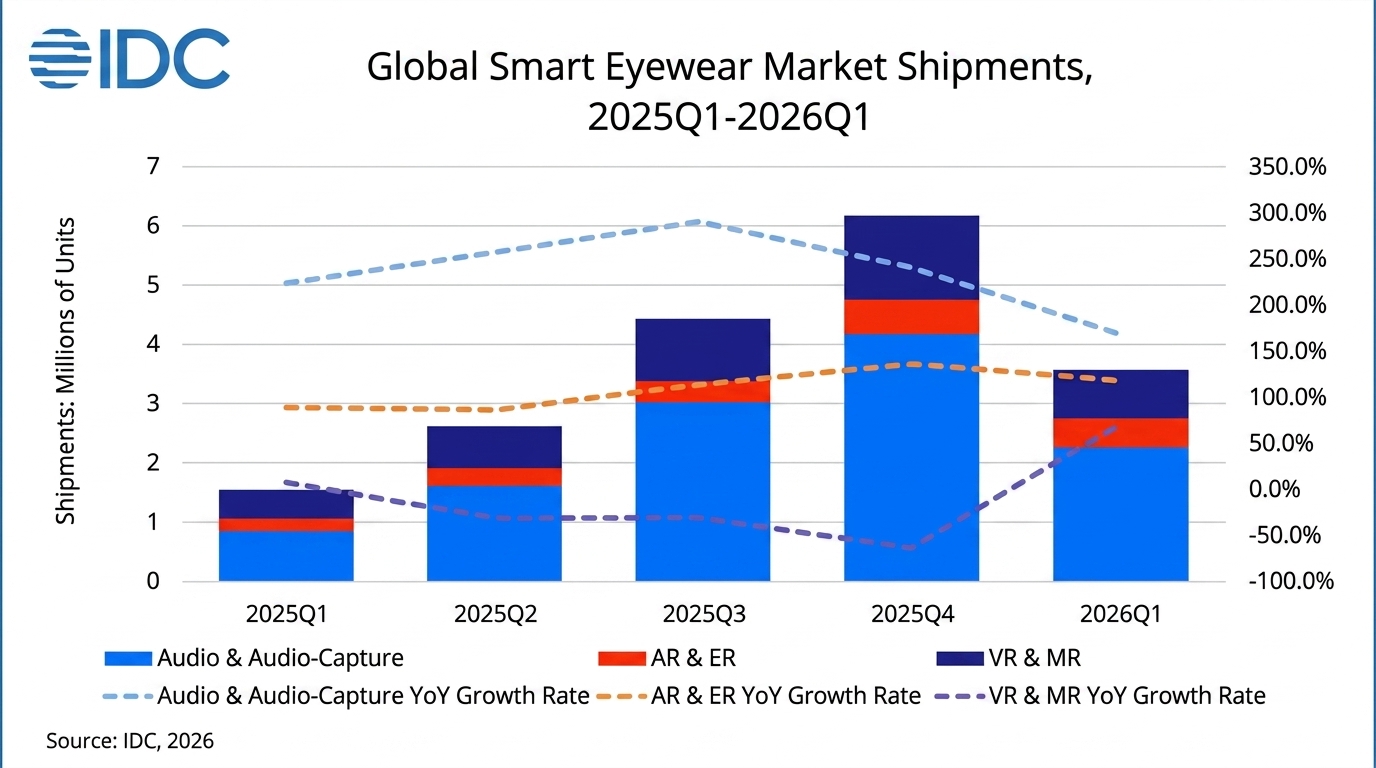
The global smart eyewear market is entering a new growth cycle, and Xiaomi is moving directly into one of the fastest-rising segments with Xiaomi AI Glasses. According to IDC’s 2026 market report, global smart glasses shipments reached 3.566 million units in Q1 2026, up 130.1% year-on-year. China also became the world’s third-largest smart eyewear market with 610,000 units shipped, showing how fast AI-powered glasses, camera glasses, and lightweight AR products are becoming mainstream.
Smart eyewear market sees explosive growth
IDC’s latest data shows that smart eyewear is no longer a niche category. In Q1 2026, the global market shipped 3.566 million units, marking a strong 130.1% year-on-year increase. The biggest driver was the rise of audio glasses, AI camera glasses, and lightweight display glasses.
The global market was mainly divided into two major categories:
This growth shows a clear shift from simple wearable audio devices to more advanced AI-powered products that can capture images, understand context, translate speech, and interact with smart home devices.
China becomes a key smart glasses battleground
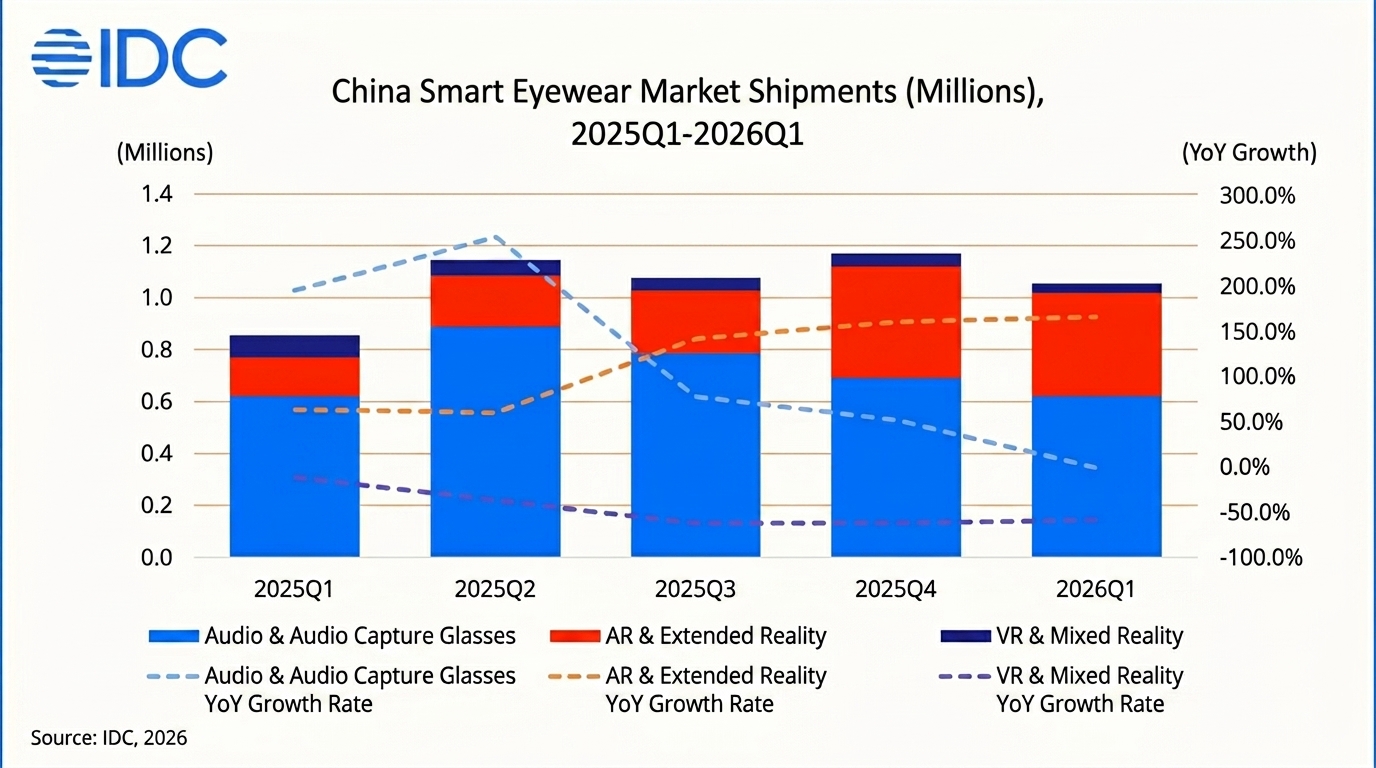
China ranked third globally in the smart eyewear market in Q1 2026, with shipments reaching 610,000 units, up 23.5% year-on-year. IDC notes that smart glasses were included in China’s national subsidy catalog for the first time, helping retailers build channel inventory and encouraging more users to try the category.
However, the market structure is changing quickly. China’s audio and audio-camera glasses segment shipped 358,000 units, almost flat with a 0.1% year-on-year decline. Pure audio glasses are starting to lose momentum, while camera glasses and AI glasses are becoming more attractive.
The most important change came from camera-enabled products. Audio-camera glasses accounted for 43.4% of China’s audio glasses segment, with shipments rising 513.1% year-on-year. This shows that users are no longer only looking for open-ear audio; they want glasses that can record, recognize, assist, and interact.
AR and display glasses are becoming the next growth engine
IDC also reported that China’s AR/VR product shipments reached 252,000 units in Q1 2026, up 86.2% year-on-year. The AR&ER category remained the strongest part of this segment, with quarterly market share exceeding 90% and year-on-year growth reaching 168.6%.
By contrast, VR&MR shipments declined 58.8% year-on-year, showing weak demand and limited new growth momentum. This suggests that lightweight, everyday smart glasses may have stronger consumer potential than bulky mixed-reality headsets in the near term.
Xiaomi AI Glasses enter the market at the right time
Xiaomi AI Glasses arrive exactly when the industry is shifting from basic wearable hardware to AI-driven daily assistants. The product is currently available only in Chinese Mainland, and many of its core features rely on Xiaomi’s Chinese ecosystem, including Xiao Ai and Xiaomi HyperOS.

The glasses are designed as an always-online AI device. Users can say “Hey, Xiao Ai” to activate Xiaomi’s multimodal assistant for object recognition, calorie counting, general questions, and smart home control. Xiaomi positions the device as a Smart Device Control Centre, allowing users to control compatible Mi Home devices by voice.