The mobile gaming landscape is about to experience a seismic shift. Following our earlier report on the surprising naming strategy for the upcoming REDMI K90 series, Xiaomi executives have now officially pulled back the curtain on the REDMI K90 Max. Launching in China this month, Xiaomi has confirmed that while a “Supreme” (Ultra) edition exists, the “Max” is officially positioned higher in the product hierarchy. For our global readers, this absolute powerhouse is expected to hit international markets under the Xiaomi 17T Pro moniker.
At the core of this device is a groundbreaking engineering feat: Xiaomi’s very first active air-cooling system integrated directly into a smartphone chassis. Let’s break down the official technical specifications and design schematics of this revolutionary thermal solution.
Engineering the Ultimate Cooling Ecosystem
Xiaomi’s philosophy for the REDMI K90 Max is simple: heat dissipation dictates the absolute ceiling of processor performance. To ensure the rumored Dimensity 9500+ chipset experiences zero thermal throttling, Xiaomi engineers completely reshaped traditional smartphone duct designs.
The 18.1mm Massive Air Intake System
The volume of air directly determines the cooling capacity. The REDMI K90 Max is equipped with an industry-leading 18.1mm large-diameter cooling fan. Utilizing a 6% vertical air inlet design and forward-inclined fan blades, the system physically pressurizes and collects air. This results in an astonishing air volume of 0.42 CFM (Cubic Feet per Minute)—rating 1.3 times higher than competing active-cooling smartphones on the market.

Simulated Vortex Air Ducts & Metal Guide Fins
Pushing air is only half the battle; routing it efficiently is where the REDMI K90 Max shines. The device employs a “Shapes with Wind” simulated vortex air duct system. This drastically reduces the turbulent flow usually caused by right-angle bends inside a phone chassis. Furthermore, Xiaomi has integrated highly conductive metal guide fins that straighten the airflow directly over the processor’s heat source. This expands the heat exchange surface area, achieving an unprecedented 78% air volume utilization rate.

Real-World Thermal Benchmarks: 10°C in 100 Seconds
What do these specs mean for actual gaming? According to Xiaomi’s official laboratory data, engaging the high-speed forced cooling mode can drop the core temperature of the device by a staggering 10°C in just 100 seconds.

Acoustic Engineering: Silent but Deadly
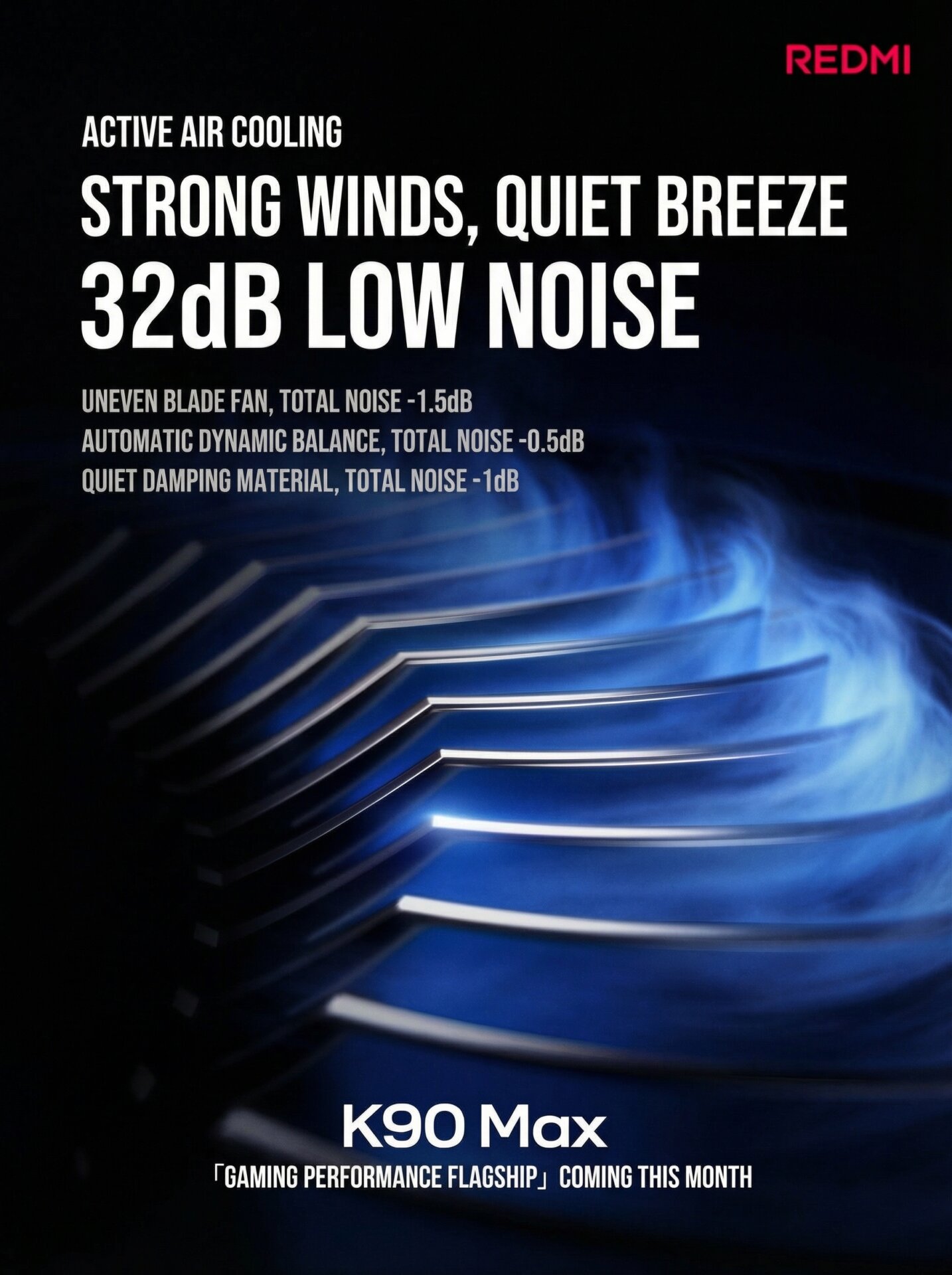
A major concern with physical fans is the distracting whirring noise. Xiaomi engineered the REDMI K90 Max to be as quiet as a bedroom at night. Even running at maximum RPM, the wind noise sits at an ultra-low 32dB. This acoustic dampening is achieved through three specific hardware choices:
-
Unequal pitch blade design: Reduces overall machine noise by -1.5dB.
-
Automated dynamic balancing: Reduces noise by an additional -0.5dB.
-
Silent shock-absorbing materials: Dampens chassis vibration by -1.0dB.
Users will also have granular control over this hardware with three distinct software speed modes, allowing them to prioritize maximum heat dissipation, absolute silence, or extended battery life depending on their current workflow.
System Enhancements
This device is a China-exclusive launch (with USD pricing pending official retail announcements). However, its existence proves that Xiaomi is no longer satisfied with passive vapor chambers for its top-tier performance devices. Running on Xiaomi HyperOS 3.1, the operating system is heavily customized to interact directly with this physical fan, utilizing advanced telemetry to dynamically spin up the 18.1mm rotor the millisecond a heavy GPU load is detected. There will be no global model with fan cooling system.