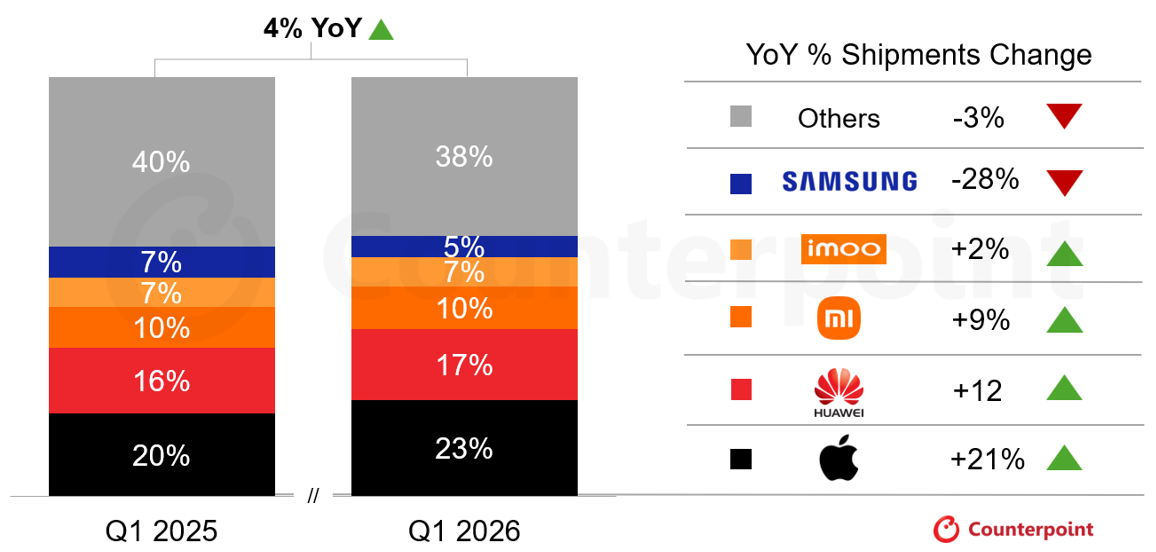
Global smartwatch shipments returned to growth in Q1 2026, rising 4% year-over-year, according to Counterpoint Research’s latest Global Smartwatch Shipments Tracker. The market was led by Apple, Huawei, and Xiaomi, with Xiaomi securing the third position globally thanks to a 10% market share and 9% YoY shipment growth. The recovery was mainly driven by stronger demand for premium health-focused wearables, Apple’s refreshed lineup, and continued momentum in China.
Core Content: Health Features Are Driving the Smartwatch Market
Counterpoint’s data shows that smartwatch buyers are increasingly prioritizing advanced health monitoring, ecosystem integration, and more affordable entry points into premium wearable platforms. Apple led the global market with a 23% share, while Huawei followed with 17%. Xiaomi reached 10%, maintaining its position among the strongest global wearable brands.
The ranking for Q1 2026 is as follows:
Market Impact: Xiaomi Strengthens Its Wearable Ecosystem
Xiaomi’s 9% YoY shipment growth is important because it shows that the company is gaining strength in a segment increasingly dominated by health tracking and ecosystem features. While Apple benefited from strong demand in North America, China and Europe were also fast-growing regions for the brand. Meanwhile, China’s smartwatch market grew 15% YoY, supported by Huawei, Imoo, Xiaomi, domestic brand preference, and consumer subsidy programs.
For Xiaomi, this means its smartwatch strategy is becoming more competitive against both premium and value-focused rivals. The company’s advantage remains its ability to combine affordable hardware, long battery life, fitness tracking, and smartphone ecosystem integration across Xiaomi HyperOS-powered devices.
Xiaomi’s third-place global ranking confirms that the company is no longer only competing in smartphones but is also building a stronger connected-device ecosystem. Smartwatches are becoming an important part of Xiaomi’s HyperOS and Xiaomi HyperConnect vision, where phones, tablets, watches, earbuds, and smart home devices work together more seamlessly.