


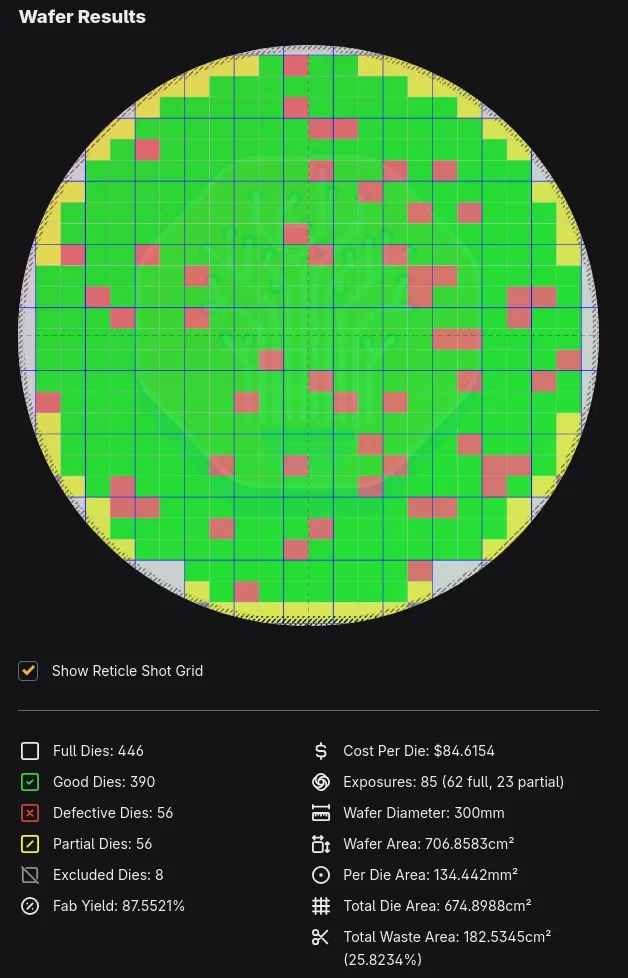
A detailed technical report from NotebookCheck has shed light on Qualcomm’s Snapdragon 8 Elite Gen 6 Pro chip, identified by the model number SM8975. The chip’s die size is approximately 134 mm², slightly larger than the Snapdragon 8 Elite Gen 5’s 126.2 mm² despite using a more advanced manufacturing process.
Manufacturing Process and Cost Analysis
The SM8975 is fabricated using TSMC’s N2P process, an enhanced 2-nanometer node, marking Qualcomm’s first flagship chip on a 2nm fabrication. The previous generation Snapdragon 8 Elite Gen 5 used the 3nm N3P process. Based on a wafer cost estimate of about $33,000 and defect rates, the raw cost per functional chip die is around $84.62, not including packaging or licensing.
CPU and GPU Architecture
The processor uses a 2+3+3 CPU core arrangement with two ultra-large cores, three performance cores, and three efficiency cores. Although earlier reports suggested a peak clock speed near 4.8 GHz, this figure remains unverified and should be treated as speculative.
The chip features an upgraded Adreno 850 GPU, replacing the Adreno 840 in its predecessor. The graphics memory (GMEM) remains at 18 MB. The GPU driver introduces a finer Dynamic Clock and Voltage Scaling (DCVS) system, offering improved frequency steps, better lag detection, and enhanced responsiveness during concurrent GPU tasks.
AI Frame Fusion and Cache Improvements
A notable addition is the AI Frame Fusion feature, which supports AI-powered super-resolution and frame generation. This capability relies on two matrix ALU units within the GPU shaders, optimized for accelerating GEMM and convolution operations. This hardware is unique to the SM8975 and absent in the standard Snapdragon 8 Elite Gen 6 (SM8950).
AI Frame Fusion can output upscaled video at 1080p or 1440p by combining motion vectors and frame data, and it can interpolate frames using motion compensation techniques to create smoother video playback.
The chip includes 16 MB of shared L2 cache and 8 MB of system-level cache, a significant increase over the previous generation. It also supports both LPDDR5X and the upcoming LPDDR6 memory standards, whereas the standard SM8950 model supports only LPDDR5X.
Modem and Connectivity Features
The SM8975 integrates Qualcomm’s new X105 modem. The RF front end combines two modules: the SDR765, built on TSMC’s N6RF process, which supports Sub-6 GHz with 2×2 MIMO uplink and 4×4 MIMO downlink, including 1024-QAM and satellite bands n253, n255, and n256.
The SDR885 supports 4×4 MIMO on both uplink and downlink with 256-QAM uplink and 1024-QAM downlink. It covers Sub-6 GHz, millimeter wave, and 3GPP Release 18 wireless standards. The module has 20 transmit ports arranged in a 7+7+3+3 layout and supports extensive diversity reception paths.
Comparison with Standard Snapdragon 8 Elite Gen 6
In contrast, the standard SM8950 is expected to feature a scaled-down Adreno 845 GPU with 12 MB GMEM and lacks the AI Frame Fusion hardware. It also supports only LPDDR5X memory.
The newly revealed details suggest the Pro version targets higher performance and more advanced AI and connectivity features.
Technical Summary
- Chip model: Snapdragon 8 Elite Gen 6 Pro (SM8975)
- Manufacturing: TSMC N2P (2nm enhanced process)
- Die size: ~134 mm²
- CPU: 2+3+3 Oryon cores (unconfirmed max clock ~4.8 GHz)
- GPU: Adreno 850, 18 MB GMEM
- AI: AI Frame Fusion for super-resolution and frame interpolation
- Cache: 16 MB L2 + 8 MB system-level cache
- Memory support: LPDDR5X and LPDDR6 (upcoming standard)
- Modem: Qualcomm X105 with SDR765 and SDR885 RF modules
At the moment, Qualcomm has not officially confirmed some performance specs or the final clock rates of the CPU cores. The new hardware details indicate a focus on AI enhancements and advanced 5G connectivity within Xiaomi and other flagship phones that may use this SoC in the future.
Source: ithome.com





Electronic components are the fundamental physical parts used in electronic circuits and devices. They are the essential building blocks that enable the functionality of everything from smartphones and computers to complex industrial machinery. Understanding the basic types of components is crucial for anyone interested in electronics, whether for hobbyist projects, professional design, or simply appreciating how everyday technology works. These components manipulate the flow of electrons in specific ways to create the desired electrical behavior within a circuit