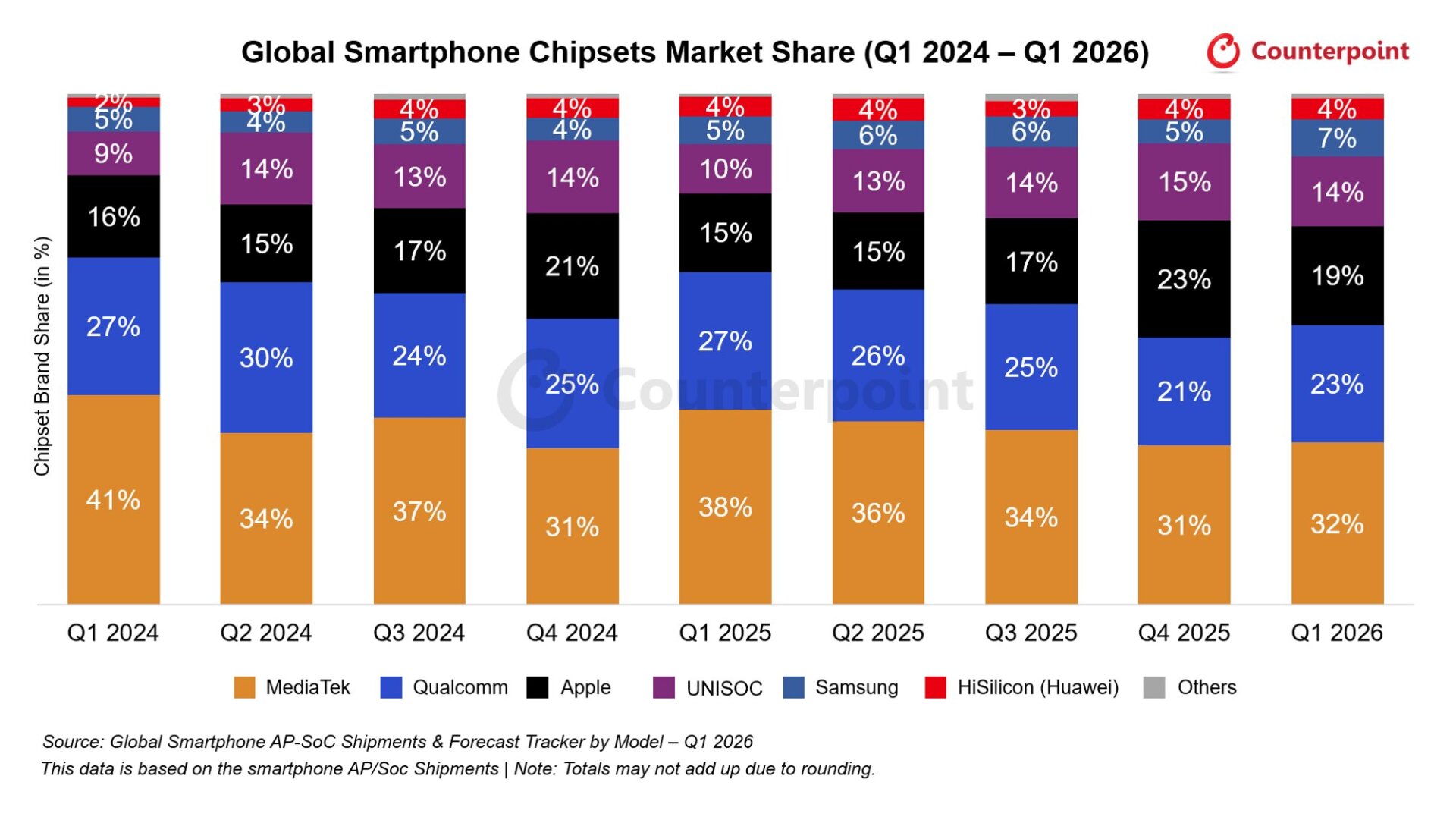
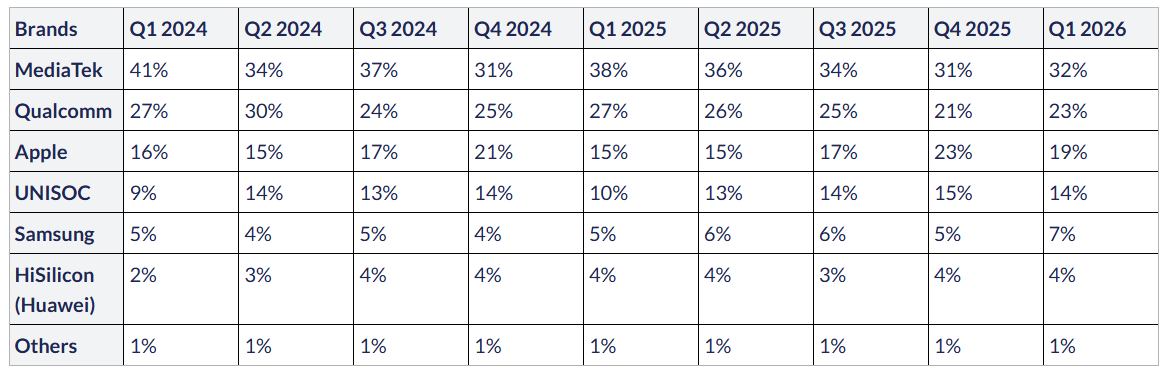
MediaTek remained the world’s largest smartphone chipset supplier in Q1 2026, and this is especially important for Xiaomi, REDMI, and POCO users. According to Counterpoint Research data, MediaTek held 32% global smartphone SoC market share, staying ahead of Qualcomm at 23% and Apple at 19%. Even though total smartphone chip shipments declined 8% year-over-year, MediaTek’s leadership confirms one thing clearly: Xiaomi’s growing use of Dimensity platforms is no longer just a cost strategy, but a core part of its global product planning.
MediaTek is still the biggest smartphone chipset supplier
Counterpoint’s Q1 2026 data shows that MediaTek continued to lead the global smartphone AP-SoC market. The company reached 32% market share, slightly higher than Q4 2025’s 31%, but lower than Q1 2025’s 38%.
For Xiaomi, this matters because MediaTek chips are now used across many important segments, from affordable REDMI models to performance-focused Xiaomi T series and POCO devices. Xiaomi no longer uses MediaTek only for low-cost phones; Dimensity chips are now directly competing with Snapdragon platforms in upper mid-range and even flagship-level devices.
Why this is important for Xiaomi
Xiaomi’s product strategy depends heavily on chipset flexibility. The company uses Qualcomm for many flagship and performance devices, but MediaTek gives Xiaomi more room to build competitive phones at aggressive prices.
This is especially visible in three key product lines: This is why MediaTek’s market leadership is not just a general industry statistic. It directly explains why Xiaomi can release so many competitive devices in different price ranges without depending on only one chipset supplier.
Dimensity chips are becoming more powerful
MediaTek’s strongest advantage is no longer only price. In recent years, the Dimensity series has improved significantly in CPU performance, GPU power, AI processing, image signal processing, and power efficiency.
For Xiaomi users, this means newer Dimensity-powered phones can offer: This is one of the main reasons Xiaomi continues to expand MediaTek usage in REDMI, POCO, and Xiaomi-branded devices. A Dimensity-powered phone is no longer seen as a weaker alternative. In many models, it is now the main reason the device can deliver strong performance at a lower price.
Memory shortage affected the whole market
Counterpoint says global smartphone SoC shipments declined 8% year-over-year in Q1 2026, mainly because of continued memory supply shortages. This affected many Android brands, especially in the entry-level and mainstream smartphone segments.
This situation is important for Xiaomi because REDMI and POCO phones often compete in price-sensitive markets. When RAM and storage costs increase, Xiaomi must carefully balance performance, memory configuration, and final retail price.
MediaTek helps Xiaomi reduce this pressure. By using efficient Dimensity platforms, Xiaomi can keep devices competitive even when memory prices make hardware planning more difficult.
MediaTek vs Qualcomm in Xiaomi phones
Qualcomm still remains extremely important for Xiaomi’s premium phones. Snapdragon chips are widely used in flagship Xiaomi models and high-performance POCO devices. However, the Q1 2026 data shows that MediaTek has a much larger shipment share globally.
This does not mean Qualcomm is weak. Instead, it shows a clear market split:
Xiaomi benefits from both. Snapdragon gives Xiaomi strong flagship branding, while MediaTek gives the company scale, pricing flexibility, and stronger coverage in global mid-range markets.