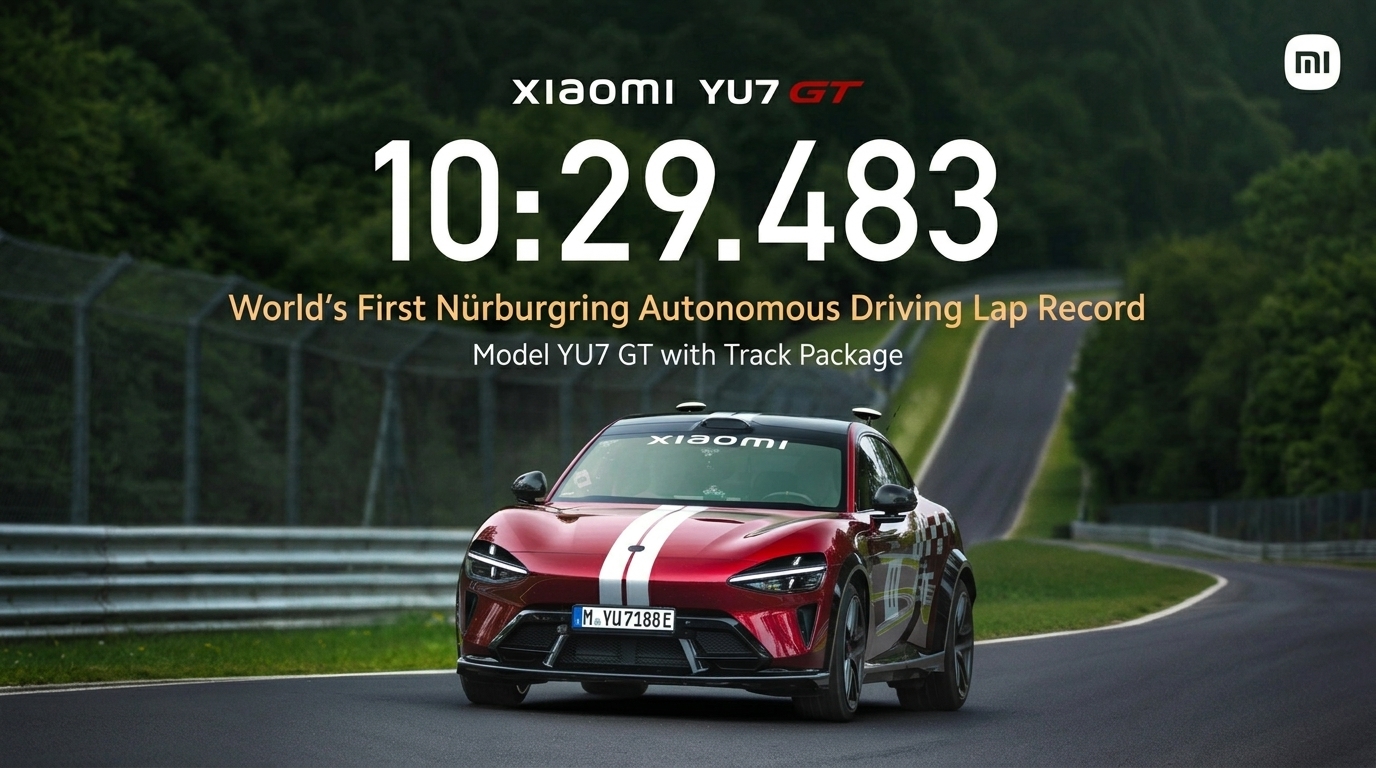
Xiaomi Auto has officially announced that the Xiaomi YU7 GT has completed what it calls the world’s first Nürburgring Nordschleife autonomous driving lap record, finishing the legendary track in 10 minutes and 29.483 seconds. The achievement is not only a performance milestone for Xiaomi’s automotive division, but also a major technical demonstration of how high-speed autonomous driving algorithms can be tested under extreme real-world conditions.
Why Xiaomi challenged the Nürburgring with autonomous driving
According to Xiaomi Auto, the Nürburgring result is not meant to show the absolute hardware limit of the YU7 GT. Instead, the company describes it as an important step for testing autonomous driving algorithms in a highly dynamic environment, where the car must react to rapid changes in speed, direction, grip, and braking pressure.
The Nürburgring Nordschleife is one of the most demanding race tracks in the world. For Xiaomi, this makes it a valuable test environment for:
- Dynamic vehicle control
- High-frequency torque distribution
- Millisecond-level emergency recovery
- Extreme cornering and braking response
- Autonomous decision-making at high speed
Xiaomi says the technologies refined on the track will gradually be transferred to mass-produced vehicles through future software and product iterations.
From race track performance to daily driving safety
The real goal of this project is not simply to chase a lap time. Xiaomi Auto says its ultimate objective is to make intelligent driving systems safer in everyday extreme situations, such as heavy rain, flooded roads, icy surfaces, or sudden loss of grip.
In Xiaomi’s words, the system should eventually act like a resident “professional race driver” inside the car, helping users make the right decision and bring the vehicle back under control when normal drivers may struggle to react quickly enough.
That makes this Nürburgring record more than a marketing event. It shows how Xiaomi is using performance testing to improve safety logic, vehicle recovery, and real-time autonomous control.
Xiaomi YU7 GT performance specifications
The Xiaomi YU7 GT was officially introduced in China on May 21. It is positioned as a sports car-level SUV and is equipped with Xiaomi’s new-generation V8s EVO super motor.
| Specification | Xiaomi YU7 GT |
|---|---|
| Maximum horsepower | 1003 hp |
| Peak power | 738 kW |
| 0-100 km/h | 2.92 seconds |
| Top speed | 300 km/h |
| CLTC range | 705 km |
| Battery | 101.7 kWh ternary lithium |
| Platform | 897V silicon carbide high-voltage platform |
| Fast charging | Up to 570 km range in 15 minutes |
| Starting price | 389,900 yuan / approx. $53,700 |
| Fully equipped version | 429,900 yuan / approx. $59,200 |
The vehicle is currently introduced for the Chinese market, with pricing officially listed in yuan.
Intelligent driving hardware
Beyond raw performance, the YU7 GT also comes with flagship-level driver assistance hardware as standard. Xiaomi has equipped the vehicle with:
- 1 LiDAR
- 1 4D millimeter-wave radar
- 11 high-definition cameras
- 12 ultrasonic radars
- Xiaomi HAD driver assistance
- NVIDIA DRIVE AGX Thor automotive computing platform
This hardware package gives Xiaomi a strong foundation for advanced assisted driving, autonomous control testing, and future intelligent driving improvements.
Autonomous lap vs professional driver lap
Xiaomi previously announced that the YU7 GT completed a Nürburgring SUV lap in 7 minutes and 22.755 seconds, breaking the SUV lap record by 14 seconds. Compared with that professional-driver lap, the autonomous driving lap of 10 minutes and 29.483 seconds is around 3 minutes and 7 seconds slower.
However, the point of this test is not to replace a racing driver today. The more important achievement is that the vehicle completed the track autonomously under extreme speed and handling conditions, creating a new benchmark for Xiaomi’s intelligent driving research.