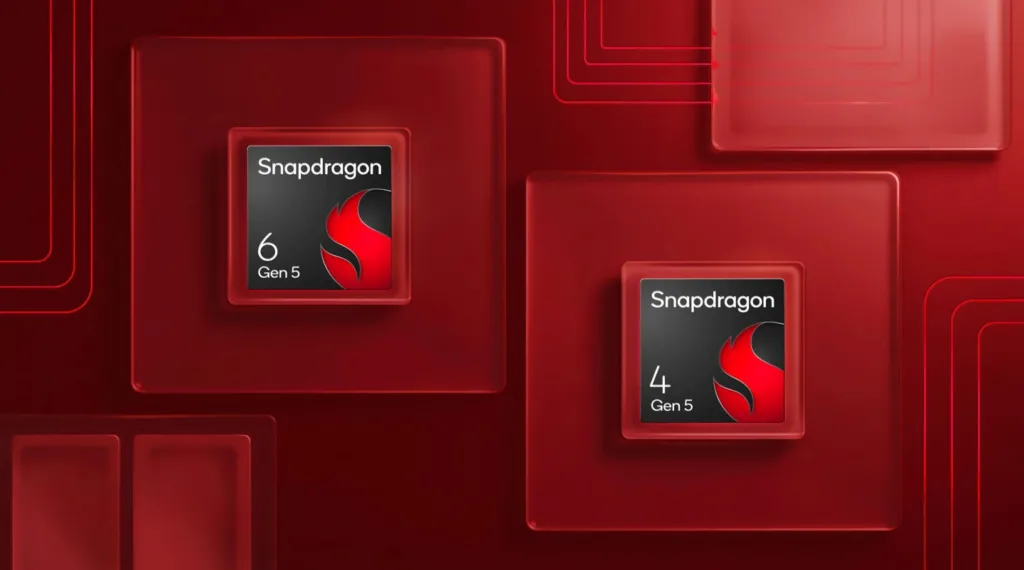

Qualcomm has officially dropped its latest silicon aimed at dominating the mid-range and entry-level markets: the Snapdragon 6 Gen 5 and Snapdragon 4 Gen 5. Slated to power end devices by the second half of 2026, these 4nm platforms bring massive GPU upgrades, next-gen connectivity, and system-level motion enhancements. While Qualcomm has laid the groundwork, the real excitement lies in how these chips will be integrated into the upcoming generation of REDMI and POCO devices, specifically tailored to run seamlessly with Xiaomi HyperOS.
Under the Hood of the New Platforms
Both new processors introduce Snapdragon Smooth Motion UI, a hardware-level optimization that will undoubtedly synergize with the fluid animation engine of Xiaomi HyperOS.
Snapdragon 6 Gen 5 (SM6850)
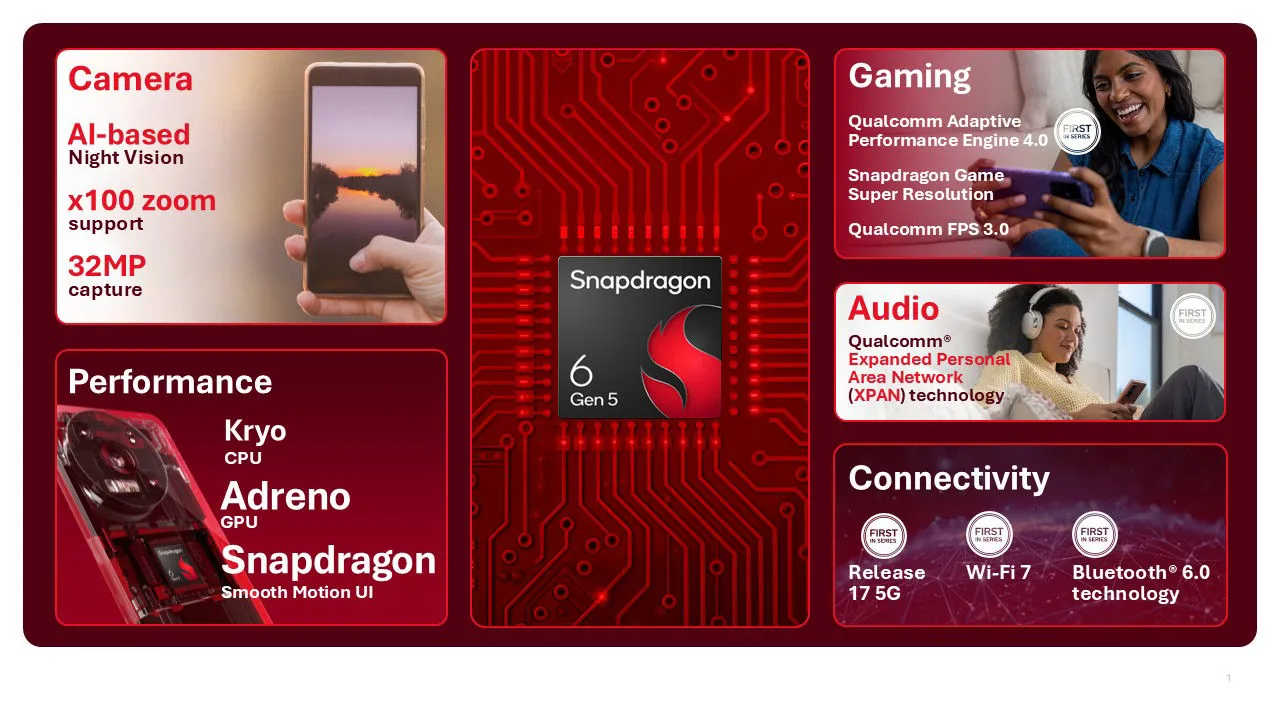
Targeting the premium mid-range segment, the 6 Gen 5 is built on a 4nm process and utilizes an octa-core Kryo CPU setup (4x 2.6GHz performance cores + 4x 2.0GHz efficiency cores).
-
Performance Boost: A respectable 21% jump in Adreno GPU performance. Smooth Motion UI specifically targets a 20% faster app launch time and an 18% reduction in screen lag.
-
Camera & AI: Features dual 12-bit DSPs supporting up to a massive 200MP capture, AI-based Night Vision, and up to x100 zoom support.
-
Connectivity Firsts: It breaks new ground for the 6-series by supporting Wi-Fi 7, Bluetooth 6.0, and Release 17 5G (up to 2.8 Gbps downlink).
-
Audio & Gaming: Introduces Qualcomm Expanded Personal Area Network (XPAN) technology and the Qualcomm Adaptive Performance Engine 4.0 for enhanced, stable frame rates via FPS 3.0 and Game Super Resolution.
-
Memory/Storage: Supports up to 16GB LPDDR5-6400 (or LPDDR4X-4200) and UFS 3.1 storage.
Snapdragon 4 Gen 5 (SM4850)
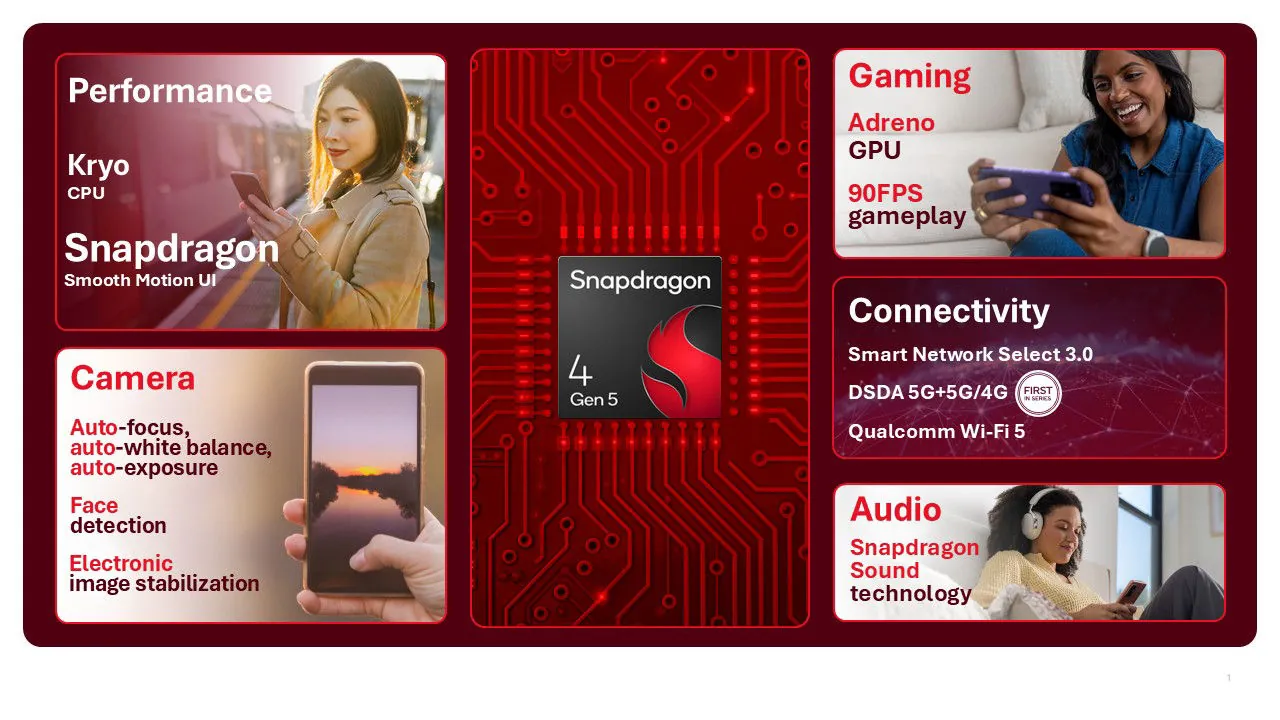
Designed to redefine entry-level smartphones, the 4 Gen 5 (also 4nm) features a 2x 2.4GHz performance and 6x 2.0GHz efficiency core configuration.
-
Massive GPU Leap: A staggering 77% improvement in GPU performance, enabling 90FPS gameplay on budget devices. Smooth Motion UI here delivers a massive 43% faster app launch and 25% less screen lag.
-
Camera: Supports up to 108MP capture with hardware-level Face Detection, Electronic Image Stabilization (EIS), and auto-focus/exposure enhancements.
-
Connectivity: Introduces Dual SIM Dual Active (DSDA) 5G+5G/4G to the 4-series, alongside Qualcomm Wi-Fi 5 and Smart Network Select 3.0.
-
Memory/Storage: Supports LPDDR4X-4267 and dual-channel UFS 3.1.
Expected Devices
While official device announcements are still under embargo, historical release cycles from Xiaomi dictate where these chips will land:
-
Target Devices: Expect the Snapdragon 6 Gen 5 to be the heart of upcoming mid-tier global models (potentially the future POCO C-series or global standard REDMI series variants). The Snapdragon 4 Gen 5 will likely dominate the entry-level POCO M-series and standard REDMI number series.
-
Target Software: Devices launching in H2 2026 with these chips will run Xiaomi HyperOS out of the box, fully optimized to utilize the new Snapdragon Smooth Motion UI alongside Xiaomi HyperConnect for seamless ecosystem integration.
How This Improves the Market
For the end user, this hardware generation bridges the gap between budget and flagship. The inclusion of FHD+ 144Hz display support across both platforms means that cheap, stuttery screens are a thing of the past. The massive 77% GPU boost on the 4 Gen 5 means entry-level REDMI buyers will finally be able to sustain 90FPS in competitive mobile gaming without heavy thermal throttling.
Furthermore, bringing Wi-Fi 7, Bluetooth 6.0, and 200MP camera support to the 6-series ensures that mid-range buyers aren’t left behind as smart home ecosystems (powered by Xiaomi HyperConnect) demand higher bandwidth and lower latency.e to drop!