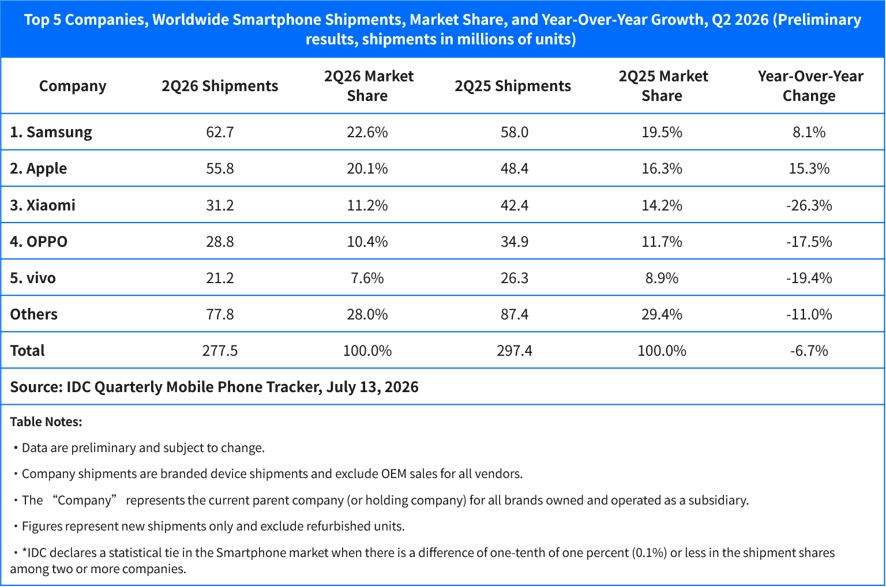
The latest IDC Global Quarterly Mobile Phone Tracker reveals that worldwide smartphone shipments dropped to 277.5 million units in Q2 2026, marking a 6.7% year-over-year decline. This is the second consecutive quarter reflecting a shipment downturn, primarily driven by a memory chip supply crisis that has significantly raised component costs and caused supply shortages. Among all brands tracked, Xiaomi experienced the steepest shipment fall, though IDC suggests this was a deliberate strategy. In contrast, leading brands Samsung, Apple, and Huawei bucked the trend with positive growth, demonstrating widening market share gaps amid challenging conditions.
Memory Crisis and Market Polarization Fuel Divergent Brand Performance
Industry research director Nabila Popal from IDC underscores the impact of soaring memory costs, which surged nearly 300% compared to last year. Memory alone accounts for above 65% of bill of materials (BOM) costs for budget smartphones, putting severe financial strain on manufacturers focused on low-end segments. This cost surge pushes manufacturers to reconsider product strategies, favouring profit-rich premium models over entry-level devices that traditionally drove volume.
Apple’s historic Q2 shipment peak was propelled by strong demand for the iPhone 17 series and consumer anticipation of future price hikes, driving preemptive purchases. Samsung equally saw shipment growth and expanded market share by 3.2 percentage points. By contrast, Xiaomi, along with OPPO and vivo, faced accelerating declines, particularly in the sub-$200 market where volume remains critical. Notably, IDC interprets Xiaomi’s sharp shipment drop as a strategic pivot away from low-margin volumes toward higher price tiers.
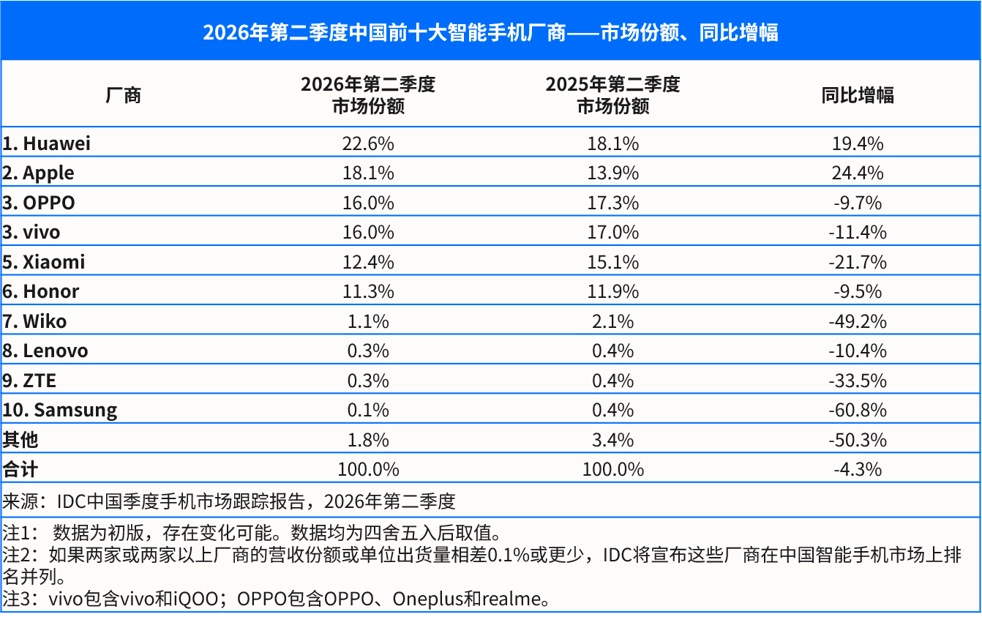
Huawei stands out by achieving an impressive 20.9% year-over-year shipment increase. This was enabled by maintaining stable domestic pricing, targeted promotions, leveraging strong local brand loyalty, and broadening product lines to cover diversified pricing segments more effectively.
Affected Brands
- Xiaomi – Largest shipment decline among top brands; intentional reduction of low-end shipments.
- Samsung – Continued growth and market share expansion in Q2 2026.
- Apple – Record Q2 shipments driven by iPhone 17 series demand and early purchase behavior.
- Huawei – Significant growth supported by domestic market resilience and promotions.
- OPPO and vivo – Declining shipments alongside Xiaomi, especially in budget segment.
- Global smartphone market – 6.7% shipment decline in Q2 2026 vs Q2 2025.
- China smartphone market – 66.01 million units shipped in Q2 2026, down 4.3% YoY, marking the fifth consecutive quarterly decline.
How This Reality Shapes the Smartphone Market and Xiaomi’s Strategy
The enduring memory chip shortage and rising costs have bifurcated the smartphone industry into two distinct camps. Premium brands like Apple and Samsung benefit from advanced memory procurement agreements and lower BOM share related to memory, insulating them from volatility and allowing continued market share gains. Conversely, value-oriented brands reliant on volume sales face mounting pressure securing and pricing memory components competitively.
Xiaomi’s approach to deliberately scale down low-end shipments reflects a strategic transition. By tightening supply of budget devices, Xiaomi aims to protect overall profitability and pivot towards higher-priced devices with improved margins—an alignment with industry trends where consumers increasingly favor premium offerings due to narrower price differentials and accessible financing options.
The price sensitivity evident in the Chinese market further highlights this challenge. Android manufacturers’ cost-driven price adjustments have cooled consumer replacement demand and contributed to the 15% drop in the mid-year “618” promotional sales event. Meanwhile, Huawei and Apple’s stable or more favorable pricing policies coupled with promotions have reinforced their competitive positioning in China’s increasingly tough smartphone environment.
What Readers Are Asking
- Why is Xiaomi’s shipment decline seen as intentional?
IDC suggests Xiaomi is deliberately reducing low-end device shipments to improve profitability by repositioning towards higher-margin models. - How have Apple and Samsung managed to grow despite the memory shortage?
They secured memory supply contracts early and memory costs comprise a smaller BOM percentage, enabling stable production and pricing. - Will Xiaomi’s strategy affect users waiting for budget devices?
Consumers relying on affordable models might face fewer new launches, but Xiaomi aims to balance this with a diversified device lineup. - What role does China’s market trends play in this scenario?
The localized price sensitivity combined with subsidy policy changes has tempered demand, impacting manufacturers differently based on their pricing strategies. - When is market recovery expected?
IDC forecasts a recovery starting around 2028–2029 as new upgrade cycles arrive and memory prices stabilize.
Source: ithome.com