MediaTek has officially introduced the Dimensity 7500, a new mainstream 5G mobile platform that brings the latest Arm C1 CPU architecture to more affordable smartphones for the first time. The platform is based on a 4nm process and combines stronger efficiency, faster AI processing, better camera support, and modern connectivity features. More importantly for Xiaomi users, upcoming Xiaomi smartphones are also expected to use this platform, and these models will not be limited to simple rebrands of existing devices.
Dimensity 7500 introduces Arm C1 CPU cores to mainstream phones
The biggest technical highlight of the MediaTek Dimensity 7500 is its new CPU structure. The chipset uses 4× Arm C1 Pro cores clocked at up to 2.6GHz and 4× Arm C1 Nano cores clocked at up to 2.0GHz. This makes the Dimensity 7500 the first mainstream mobile SoC to adopt the Arm C1 series CPU core design, bringing newer-generation CPU efficiency to devices below the flagship segment.
This architecture should make mid-range smartphones feel faster in daily usage. App launching, multitasking, social media browsing, system animations, and background task handling can all benefit from a more modern CPU design. For Xiaomi and REDMI devices, this may also help HyperOS feel smoother on more affordable smartphones without requiring a flagship-class processor.
Core specifications of MediaTek Dimensity 7500
The Dimensity 7500 is designed as a complete mainstream 5G platform with strong support for displays, cameras, storage, AI, and connectivity. Its specifications make it suitable for performance-focused mid-range smartphones that need high refresh rate screens, large camera sensors, and reliable gaming performance.
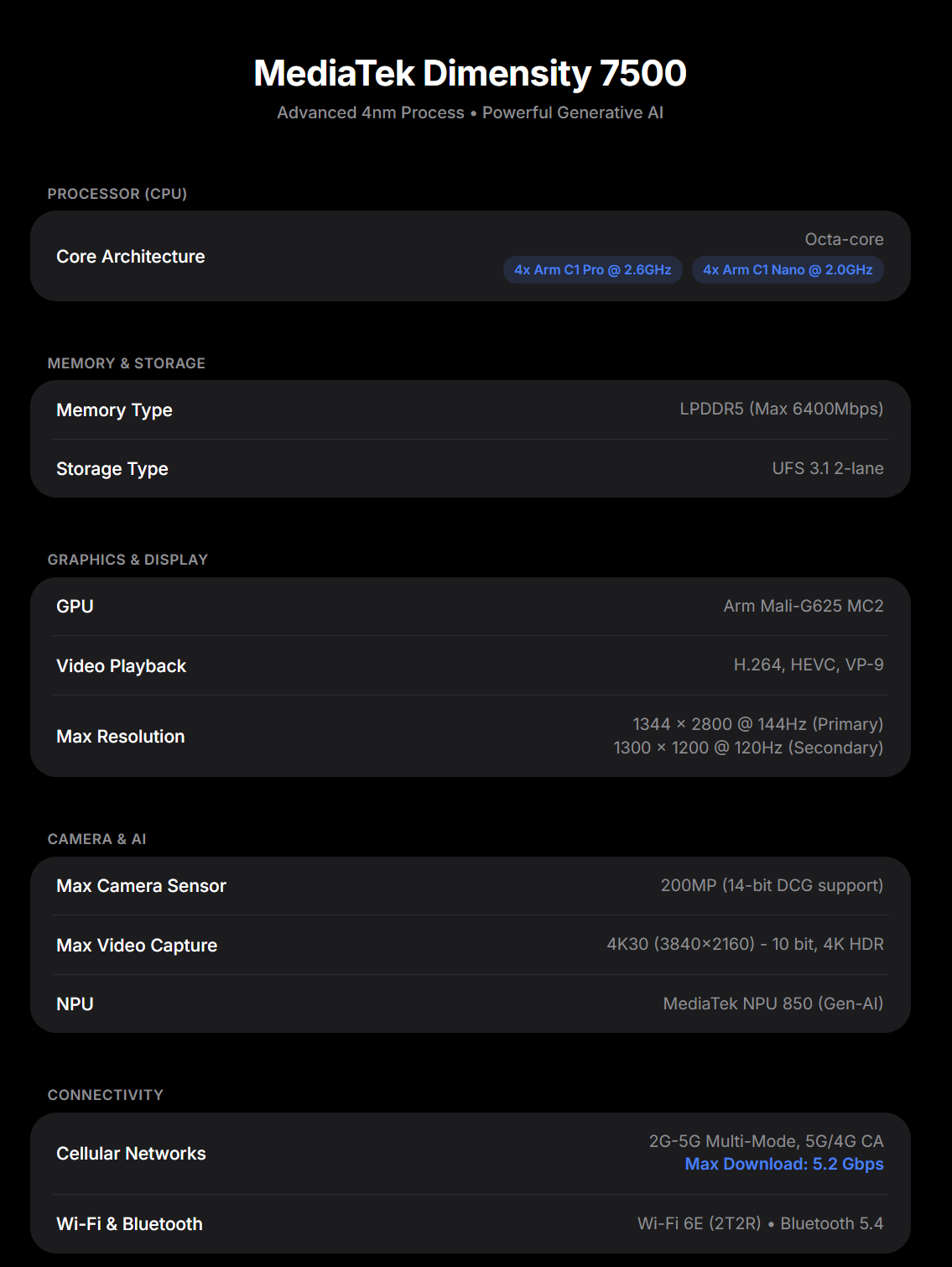
MediaTek Dimensity 7500 key specs:
- Process: 4nm
- CPU: 4× Arm C1 Pro up to 2.6GHz + 4× Arm C1 Nano up to 2.0GHz
- GPU: Arm Mali-G625 MC2
- Memory: LPDDR5-6400 support
- Storage: Dual-channel UFS 3.1
- 5G downlink: Up to 5.2Gbps
- Wi-Fi: Wi-Fi 6E 2T2R
- Bluetooth: Bluetooth 5.4
- Main display: Up to 1344×2800 at 144Hz
- Secondary display: Up to 1300×1200 at 120Hz
- Camera: Up to 200MP lens support
- Video: 4K 30fps 10-bit recording
- AI: MediaTek NPU 850
These features show that MediaTek is not positioning the Dimensity 7500 as a basic entry-level chip. Instead, it targets mainstream smartphones that still need premium-style features such as 144Hz displays, 200MP cameras, faster storage, and improved AI acceleration.
AI performance receives a major upgrade
The Dimensity 7500 includes the MediaTek NPU 850, which brings more than 100% higher AI performance compared to its predecessor. This improvement can support smarter camera processing, faster image enhancement, better voice-related features, and more efficient on-device AI tasks.
AI performance is becoming increasingly important for Android smartphones, especially as brands integrate more local intelligence into camera apps, galleries, system optimization tools, and assistant features. For Xiaomi phones, stronger NPU performance could help future HyperOS features run faster and more efficiently on mid-range hardware.
Better efficiency for daily apps and gaming
MediaTek says the Dimensity 7500 improves energy efficiency by 5–9% in popular everyday applications and 4–7% in popular gaming applications. These gains may look small on paper, but they can matter a lot in real usage, especially for phones with high-refresh-rate displays and large background workloads.
The chipset also improves several practical performance areas. According to the provided data, video transcoding speed can increase by up to 68%, file transfer speed by up to 40%, and app switching speed by up to 30%. These are the types of improvements users may notice directly, especially when moving between apps, sharing large files, editing videos, or using the phone heavily throughout the day.
Xiaomi will use Dimensity 7500 in original new phones
One of the most important market details is that Xiaomi will also release smartphones using the MediaTek Dimensity 7500 platform. These devices are not expected to be limited to simple rebrands, which means Xiaomi may build original new models directly around this chipset instead of only renaming an existing China or global device.
This is important because Xiaomi often uses different names across China, global, India, REDMI, and POCO lineups. However, a non-rebrand Dimensity 7500 phone would suggest a more direct product strategy, where the hardware is designed specifically for its target market or series. That could make the chipset relevant for upcoming Xiaomi, REDMI, or POCO devices depending on Xiaomi’s final product positioning.
Market impact for mid-range Android phones
The Dimensity 7500 could become a strong platform for upcoming mainstream 5G smartphones. Its combination of Arm C1 CPU cores, LPDDR5 memory, UFS 3.1 storage, Wi-Fi 6E, Bluetooth 5.4, 200MP camera support, and improved AI processing makes it competitive for mid-range devices that need strong specifications without flagship-level cost.
For Xiaomi, this chipset could be useful in phones focused on battery life, smooth HyperOS performance, camera resolution, and value-oriented gaming. If Xiaomi uses the Dimensity 7500 in original new models, it may help the company strengthen its mid-range portfolio against Qualcomm Snapdragon 7-series and Snapdragon 6-series alternatives.
Xiaomi’s strategy
Xiaomi’s possible use of the Dimensity 7500 shows how the company continues to diversify its hardware platforms across different price segments. Instead of relying only on flagship Snapdragon or high-end Dimensity chips, Xiaomi can use newer mainstream platforms to improve performance, efficiency, and AI capabilities in more affordable devices.