Xiaomi has officially begun transitioning its MiMo-V2 series to the new MiMo-V2.5 model family , a significant update for developers using Xiaomi’s AI platform. The affected models are mimo-v2-pro , mimo-v2-omni , mimo-v2-flash , and mimo-v2-tts . According to Xiaomi’s announcement, these older model names will be completely retired at 00:00 Beijing time on June 30, 2026, meaning that API calls using the old names will no longer work after that date.
What changes with the Xiaomi MiMo-V2 models?
Xiaomi is replacing several MiMo-V2 model names with newer MiMo-V2.5 versions. Before the final retirement date, the platform will have a transition period during which requests submitted for the old model names will be automatically redirected to their newer equivalents.
This automatic replacement helps developers migrate gradually without immediately breaking existing apps. However, Xiaomi clarifies that after the final retirement date, the names of the old model names will no longer be valid, and API requests using them will return error messages.
MiMo-V2 to MiMo-V2.5 Replacement Rules
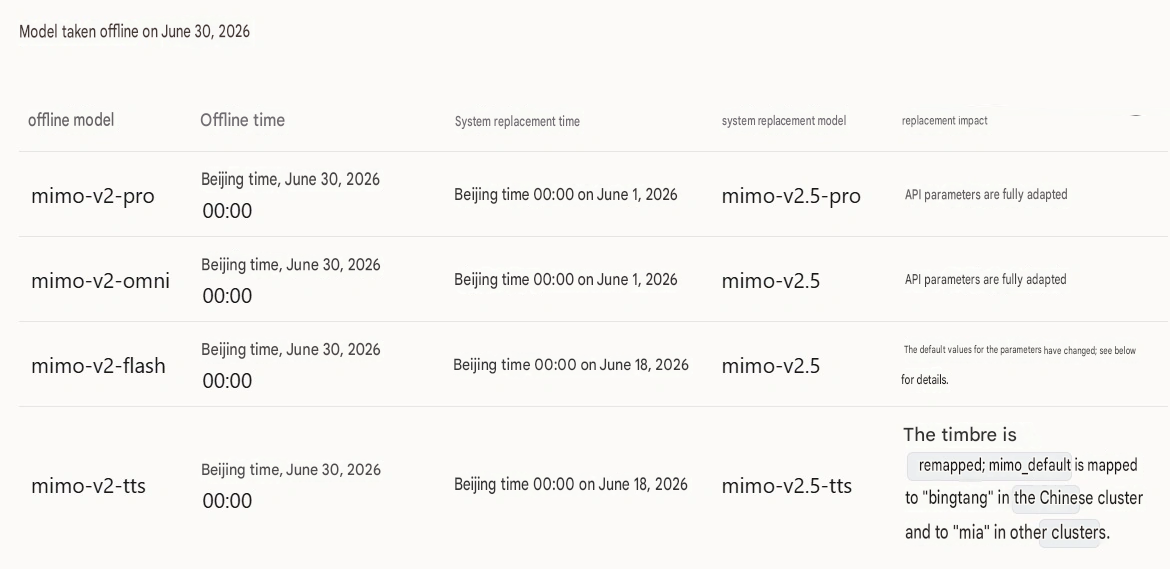
The migration affects four model names of Xiaomi’s AI platform:
Xiaomi notes that mimo-v2-pro and mimo-v2-omni are fully compatible with their replacement models at the API parameter level. This means that most developers shouldn’t need to make significant code changes during the migration process, although business logic, pricing, and voice output should be carefully reviewed.
Affected models and important dates
Starting June 30, developers must directly use the new MiMo-V2.5 model names. Any service that continues to call the old MiMo-V2 model names may experience request failures.
What you should know
The most significant technical change is that legacy model names will no longer be treated as aliases in the long term. Xiaomi is only offering temporary automatic redirection during the transition period. Developers must update their API configuration, model selection logic, backend redirection rules, and billing checks before the final deadline.
Regarding voice generation, the migration from MIMO-v2-TTS to MIMO-v2.5-TTS also changes how voice tones are assigned. The previous ringtone system is no longer used directly. Instead, Xiaomi applies a region-based assignment:
This means that developers using text-to-speech output should check whether the new voice assignment affects pitch, pronunciation, voice consistency, or user experience in production services.
How this update improves Xiaomi’s AI platform
The transition to MiMo-V2.5 provides Xiaomi with a cleaner and more unified AI model structure. Instead of maintaining the old V2 model names across different product categories, Xiaomi is guiding developers toward a newer model family with updated voice model routing, billing, and behavior.
For users and developers, the biggest advantage is long-term stability. The automatic routing period reduces migration risk, while the final deadline of June 30th gives developers a clear timeframe to complete the adaptation work. This is especially important for applications, tools, and services that rely on Xiaomi’s AI models for agent workflows, multimodal tasks, and voice generation.